This section provides updated information about fugue.us.
5.23.2026
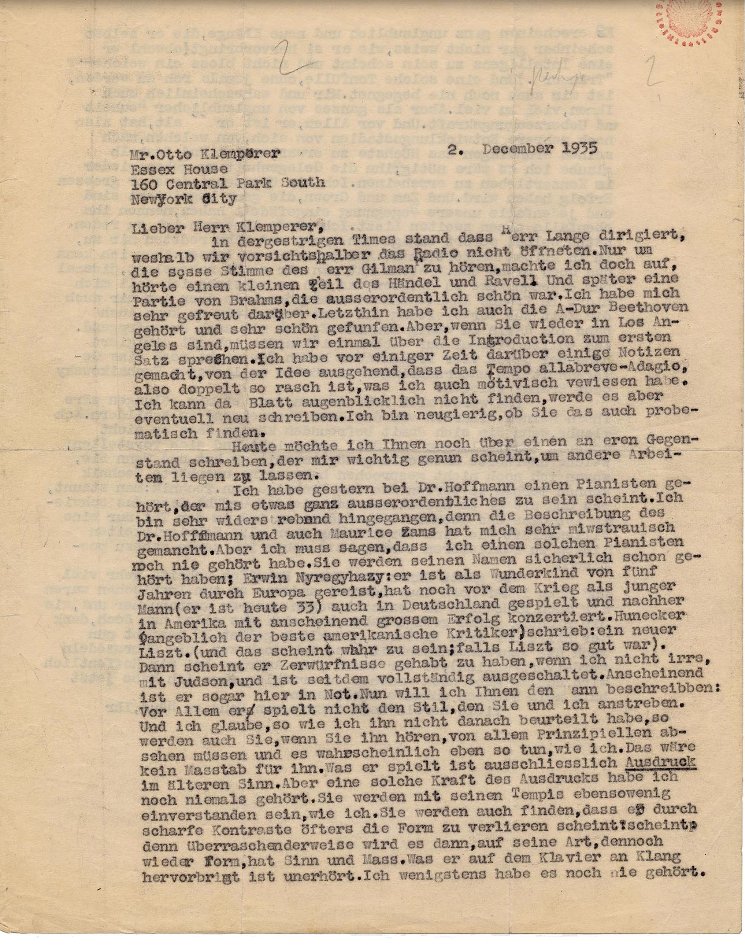
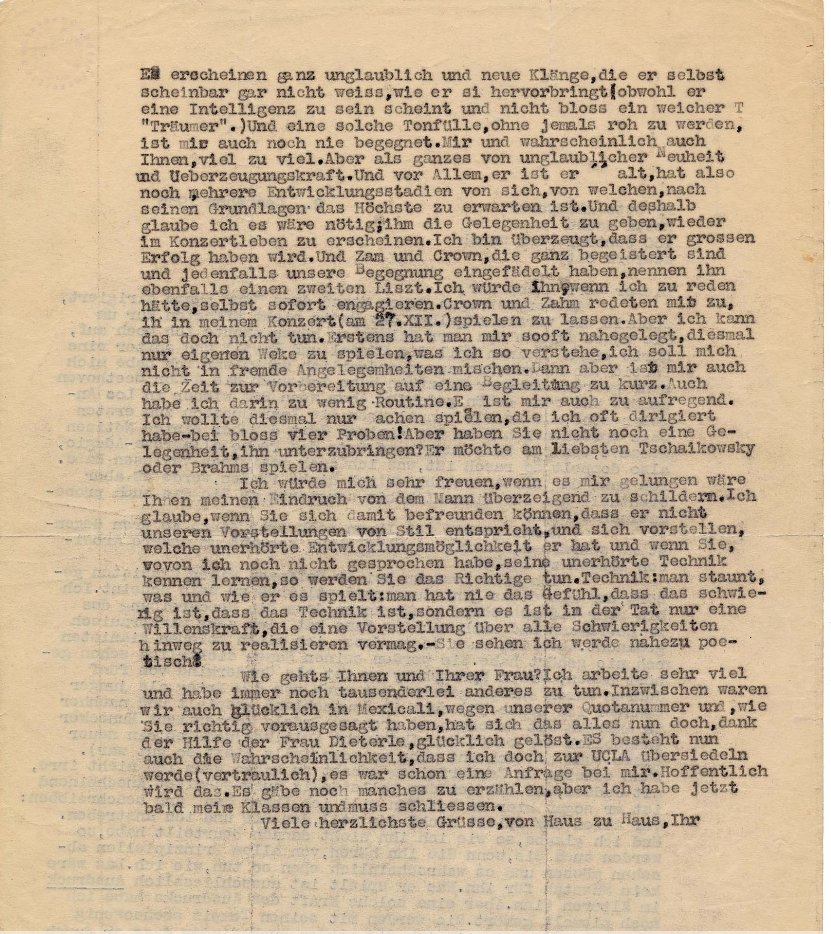
I've just come across the original German letter that Arnold Schoenberg wrote about Ervin Nyiregyházi in 1935. The English translation has been widely circulated and also included in 'Lost Genius', but I don't think many have seen the original version. Even Kevin Bazzana was not aware of this.
https://archive.schoenberg.at/letters/letters.php?id_letters=2791&action=view&sortieren=Filing_Element&vonBis=0-19
In December 1935, hearing Nyiregyházi at his friend's house, Schoenberg was so excited that he called Nyiregyházi 'the person most replete with genius I have ever heard'. The next morning, he sent the following enthusiastic letter to Otto Klemperer.
"Yesterday, I heard a pianist at Dr. Hoffmann's house who seems to me quite extraordinary. I went very reluctantly, because the descriptions by Dr. Hoffmann and also Maurice Zams made me very suspicious. But I must say that I have never heard such a pianist before. You will certainly have heard his name: Erwin Nyregyhazy. As a child prodigy at five, he toured Europe, played in Germany as a young man before the war (he is 33 now), and afterwards gave concerts in America with apparently great success. Hunecker (supposedly the best American critic) wrote: a new Liszt. (And that seems to be true; if Liszt was that good). Then, if I'm not mistaken, he seems to have had a falling out with Judson, and has been completely out of the picture ever since. Apparently, he is even destitute here.
"Now I will describe the man to you: First and foremost, he doesn't play in the style that you and I strive for. And I believe that, just as I haven't judged him by that standard, you too, when you hear him, will have to disregard all principles and probably do just as I did. That would be no measure of his skill. What he plays is exclusively expression in the older sense. But I have never heard such power of expression. You will disagree with his tempi as much as I do. You will also find that he often seems to lose form through sharp contrasts—seems, because surprisingly, in his own way, it nevertheless regains form, has meaning and measure. What he produces in terms of sound on the piano is unheard of. I, at least, have never heard anything like it. Incredibly new sounds emerge, sounds which he himself seems unaware of how he produces (although he appears to be intelligent and not merely a soft "dreamer"). And such a richness of tone, without ever becoming harsh, is something I have never encountered before. Far too much for me, and probably for you as well. But as a whole, it possesses incredible novelty and persuasive power. And above all, he is old, meaning he still has several stages of development ahead of him, from which, given his foundations, the highest potential can be expected. Therefore, I believe it is necessary to give him the opportunity to reappear in concert life. I am convinced that he will be a great success. And Zam and Crown, who are quite enthusiastic and, in any case, arranged our meeting, also call him a second Liszt. If I had the power to negotiate, I would engage him immediately. Crown and Zam urged me to let him play in my concert (on December 27th). But I simply cannot do that. Firstly, I've been repeatedly advised to play only my own works this time, which I understand to mean I shouldn't meddle in other people's affairs. But then, the time to prepare for an accompaniment is too short. I also lack sufficient experience in this area. It's also too nerve-wracking for me. This time I only wanted to play pieces I've conducted often—with only four rehearsals! But don't you have another opportunity to include him? He would most like to play Tchaikovsky or Brahms.
"I would be very pleased if I have succeeded in convincingly conveying my impression of the man. I believe that if you can accept that he doesn't conform to our ideas of style, and imagine the extraordinary potential for development he possesses, and if you become acquainted with his remarkable technique, which I haven't yet mentioned, then you will be doing the right thing. Technique: one marvels at what and how he plays it: one never gets the feeling that it's difficult, that it's a matter of technique, but rather it's simply a sheer willpower capable of realizing a vision despite all difficulties. You see, I'm becoming almost poetic."
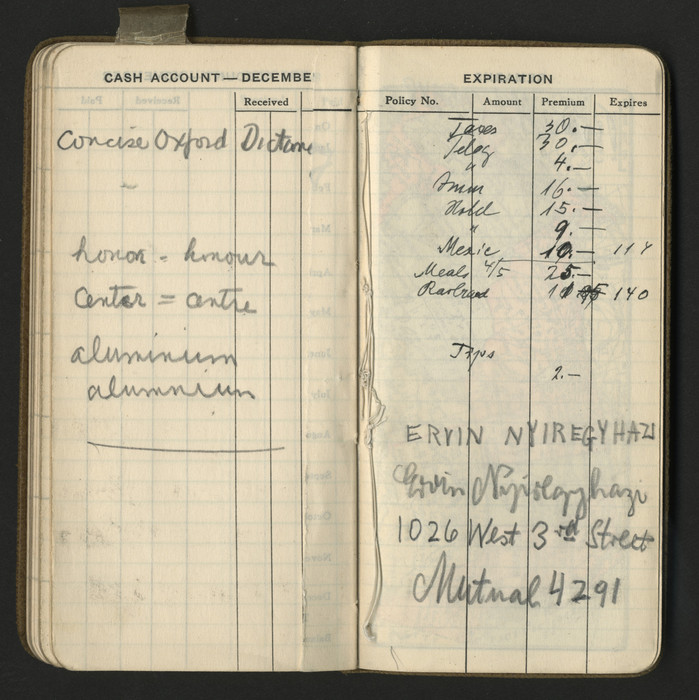
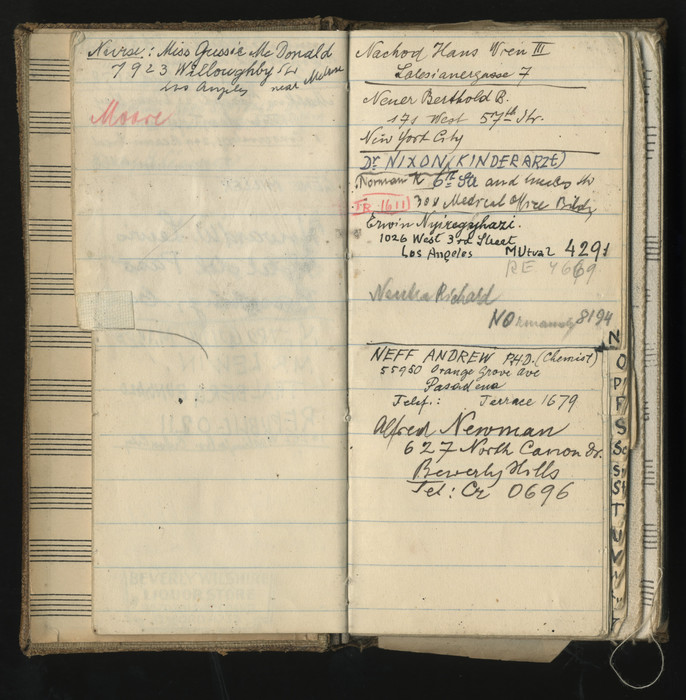
I also encountered a photo of Schonberg's diary, where Nyiregyházi himself wrote down his name and address presumably in the occassion they met first time at Dr Hoffman's house.
https://archive.schoenberg.at/resources/pages/view.php?search=nyiregyhazi&k=&modal=&display=thumbs&order_by=relevance&offset=0&per_page=48&archive=&sort=DESC&restypes=1%2C2%2C5%2C6%2C7%2C8%2C9%2C12&recentdaylimit=&foredit=&noreload=true&access=&ref=13469
2.2.2026
Nyiregyházi Live Vol. 4 is to be released on Feb 18, 2026!
Pre-order is availale from Sonetto Official Store.
1.25.2026
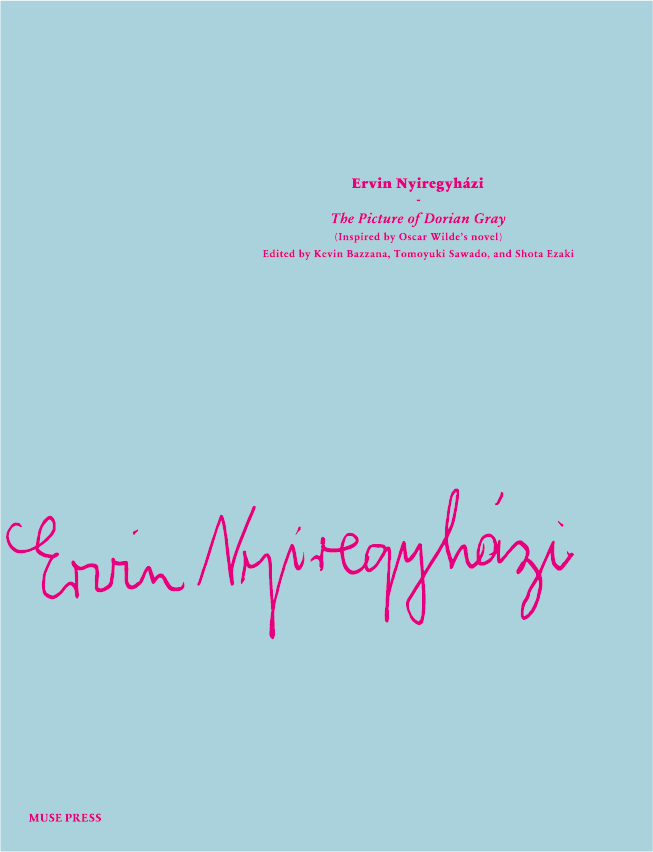
Nyiregyházi considered it to be his greatest work, but it was once thought to be lost. Several years ago, we discovered two copies of the score in Sonetto Archive and began working with Muse Press.
It is available from the Muse Press store.
Stay tuned--we will soon announce the release of our new EN album!
12.4.2024
American pianist Raymond Lewenthal (1923-88) is widely credited with reviving the music of Charles-Valentin Alkan in the 1960s. His path has been followed by pianists of the next generations, most notably Marc-André Hamelin, who was introduced to one of Alkan albums and scores by Lewenthal at the age of 7.
It was not widely known, however, that Ervin Nyíregyházi played a key role in the Alkan revival.
Lewenthal was a great admirer of Nyíregyházi during his teenage years in the 1940s, and he met Nyíregyházi at an event in CA. Lewenthal asked Nyíregyházi about this strange composer he had come across in his reading, Alkan, and Nyíregyházi played him the opening of "étude Le chemin de fer", introducing Lewenthal to Alkan's music.
Visit the link to find the unpublished article Lewenthal wrote about the incident (p7)
https://johnkersey.org/2024/08/13/raymond-lewenthal-on-ervin-nyiregyhazi/
9.25.2024
On 29 July 1973, Nyiregyházi performed at R. Antonioli's house as his fourth recital since his return. The official programme included Schubert A-minor sonata Opus 42 in the second half. The programme written by Nyiregyházi himself also included the sonata.
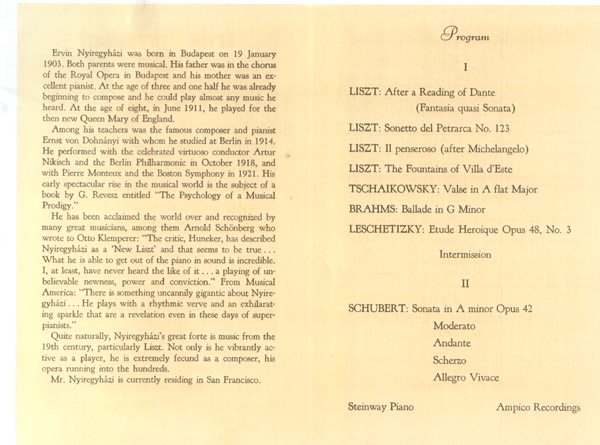
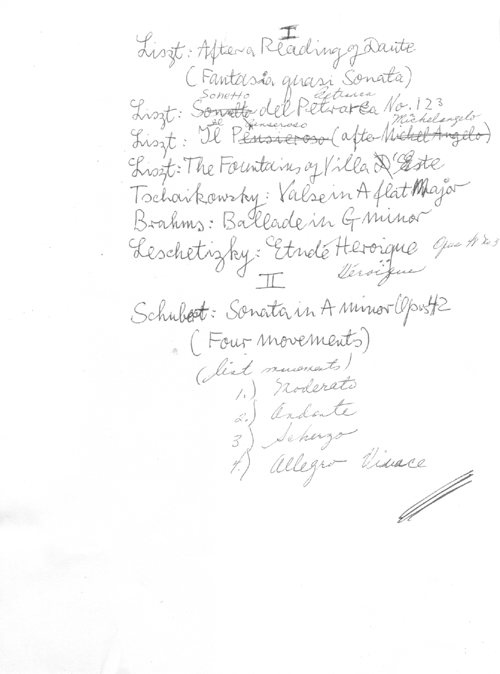
We have not encountered the recording of his Schubert sonata. Did he really play it? Some years ago, the late Ricardo Hernandez gave us the original tape of this recital. Although we have not yet checked the tape, there was a piece of paper about the contents of the tape. There was no mention of a Schubert sonata.
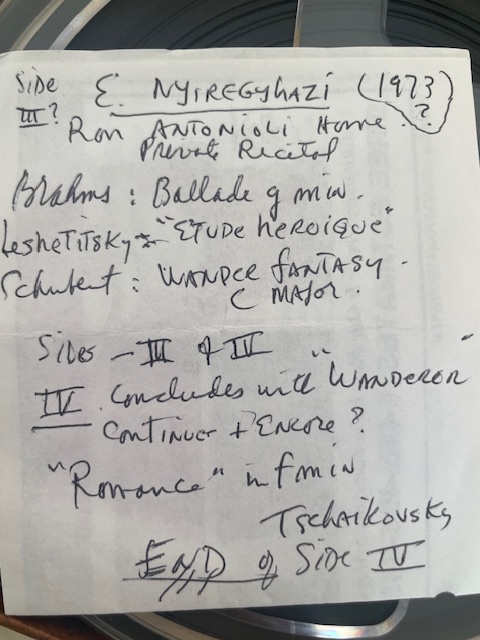
According to the AMICA report written by an AMICA member right after EN's recital, he apparently changed the Schubert's A minor sonata to 'Wanderer Fantasie' at the last moment. So there is no recording of his A-minor sonata. What a shame!
9.14.2024
There used to be a wonderful quarterly magazine called the Classical Recordings Quarterly (CRQ), though it ceased publication in 2015. Then, in 2022, critic Joe Moore, who had contributed to CRQ, launched the Liner Notes Magazine (https://liner-notes-magazine.com/), which is positioned as a successor to CRQ.
Liner Notes Magazine and CRQ also differ slightly in character: while CRQ focused on recordings, the Liner Notes Magazine focuses not only on recordings, but also on people around the record and music industry, such as producers, photographers, engineers, etc.
The Spring 2022 issue (issue 2) featured an interview with me, which you can read online for free (https://liner-notes-magazine.com/articles/label-spotlight-sonetto-classics/). Other issues have featured people like Mark Ainley, Tony Faulkner, Norma Fisher, and Ward Marston.
The regular annual subscription fee is $20, but there is a 20% discount code (SC20). With the code, the fee is $16 for the first year, reverting to the normal $20 for the second year. It's a rich, interesting journal. Give it a try.
3.31. 2024
My 2021 interview with the Liner Notes Magazine is now available on line. I discussed Sonetto projects, Nyiregyházi, Norma Fisher, Angelo Villani, and myself a bit.
https://liner-notes-magazine.com/articles/label-spotlight-sonetto-classics/
3. 4. 2024
We are looking for project sponsors who can support our Nyiregyházi CD projects.
Call for Sponsorship
We are a dedicated team committed to bringing the stories and music of Ervin Nyiregyházi to life. We are seeking sponsorship from individuals who understand the value of preserving our musical heritage. By sponsoring our historical CD releases, you will not only support the production and distribution of his unique albums but also become an integral part of our mission to inspire, educate, and entertain audiences worldwide.
Our next project will be: Nyiregyházi Live Vol. 4: R. Antonioli's House, California, 1973.
We have the original reel-to-reel tape of this recital. The program indicates that he played Liszt, Brahms, Tchaikovsky, and Schubert A minor Sonata (!), although we have not yet confirmed that the tape actually contains the Schubert piece.
As a full project sponsor (4500 pounds), you will receive CD copies and some archival photo prints as well as recognition in the album booklet, press releases, social media campaigns, and official web page. Your generous sponsorship will not only help us produce his albums but will also contribute to the preservation and promotion of cultural heritage for future generations.
Together, we can ensure that the voice of one of the most idiosyncratic musicians in the 20th century continue to resonate with audiences today and for years to come. To learn more about sponsorship opportunities and how you can support our historical CD projects, please contact info(at)sonettoclassics.com.
For more details, please visit Sonetto HP.
12.26.2023
I would just like to share a couple of paragraphs from an essay by Gregor Benko, president of International Piano Archives, that appeared in the March 1994 issue of Gramophone magazine.
-----
One of the promotional events involved ‘recitals’ of the tapes (=Nyiregyházi's Liszt recordings) made so far over an expensive system of speakers installed in a small auditorium in the Foundation’s New York headquarters. I took Alicia de Larrocha to that recital, and while she was most enthusiastic, I do not remember her ever stating she thought he was a “genius”. An interesting sidelight: after the Ford Foundation taped recital, de Larrocha and I ran into her old friend Clifford Curzon at lunch. He was affable and genial until she, spilling over with praise and enthusiasm for the tape she had just heard. made the comment that she thought Nyiregyhazi had “the real Liszt sound”. Curzon stiffened, made a face and left our table hurriedly, saying “Others of us play Liszt too!"
------
Several years ago, Benko wrote about this incident again for a concert program dedicated to de Larrocha. In that version, de Larrocha, who was initially "suspicious of recordings" but "was very impressed and moved by the tape", said: “The man’s Liszt playing is incredible – he has the real piano sound for Liszt.”, which was followed by Curzon's furious reaction. Incidentally, one might think that de Larrocha had little to do with Liszt's music, but 10 years ago, I did a blind listening test of 108 recordings of Liszt's B minor sonata. Much to my surprise, the winner was de Larrocha's Decca recording.
6.11.2023
Jed Distler's radio show 'Between the Keys' (WWFM) featuring Norma Fisher entitled ”Celebrating Norma Fisher” was broadcast on June 6th and 7th. Now the podcast is available here. Interviewed by Jed Distler, Norma discuss her teaching philosophy as well as her mentors Bachauer and Kabos, and Arrau, Ogdon, Annie Fischer, Sokolov, etc.
For "Nyiregyházi Live Vol. 3", we have seen three good reveiws so far:
Jed Distler's disc review has also appeared in Classics Today.
".....everything comes together in the aforementioned Liszt Legendes. Nyiregyházi’s expansive shaping of No. 1’s long trills and runs creates a most ethereal atmosphere, while No. 2 evokes not so much rippling undercurrents as the mightiest ocean storm."
".....this third volume of Sonetto Classics’ live Nyiregyházi trilogy is the most compelling document we have of one of the 20th century’s most difficult yet fascinating piano personalities."
A review by Stephen Greenbank on "Nyiregyházi Live Vol. 3" has been published in MusicWeb International.
"He conjures up some wonderful colourful sonorities in No. 1: St. Francis of Assisi preaching to the birds. Utilizing myriad pianistic effects such as tremolos and trills, he paints a radiant impressionistic canvas of avian gatherings. No. 2: St Francis of Paola walks on the waves is a hymn of thanksgiving for a safe crossing of the Straits of Messina. The journey was not without its dangers, and the menacing chromatic scales bear witness to the event. Nyiregyházi delivers a reading of great tumult and thunderous power."
"The album will appeal both to fans of Ervin Nyiregyházi and aficionados of the art of piano."
Finally, Mark Ainley wrote an enthusiastic review, which is available here.
".....this new release featuring entire concert by Sonetto Classics is certainly far more impressive than what we have heard from this fabled recital before." "Truly mesmerizing and highly individual pianism miraculously captured 50 years ago today and now available complete for the first time ever. "
5.14.2023
I've just found this episode of "Between the Keys with Jed Distler" (WWFM.org), which was aired last November. In Jed's "ideal" Brahms Op. 116 cycle with a different pianist for each piece, for Op 116 No 2, he has chosen Norma's recording (Norma Fisher at the BBC Vol. 3) as "a very personal, exquisitely detailed, and totally heartfelt interpretation."
5.8.2023
Jed Distler's disc review has
just appeared in Classics Today.
"Nyiregyházi’s expansive shaping of No.
1’s long trills and runs creates a most ethereal atmosphere,
while No. 2 evokes not so much rippling undercurrents as the
mightiest ocean storm."
".....this third volume of Sonetto
Classics’ live Nyiregyházi trilogy is the most compelling
document we have of one of the 20th century’s most difficult
yet fascinating piano personalities."
5.6.2023
"Nyiregyházi Live Vol. 3: Old First Church, 1973" has been released today. The album is available from